
Assessment and Optimization of 2T Perovskite/CIGS Tandems via Data-Driven and Optoelectronic Modelling

Corresponding Author: Aldo Di Carlo
Nano-Micro Letters,
Vol. 18 (2026), Article Number: 312
Abstract
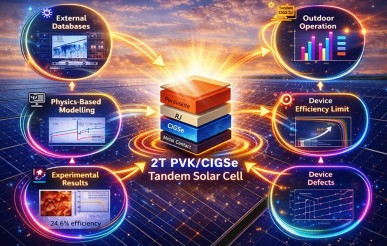
The global transition to a fossil-free energy system highlights the need for photovoltaic technologies that combine high efficiency with scalability, durability, and flexibility. Monolithic perovskite/Cu(In,Ga)Se2 tandem solar cells (TSCs) are an attractive thin-film alternative to perovskite/silicon TSCs, combining low-temperature processing, mechanical flexibility, and radiation tolerance. However, their practical potential remains constrained by coupled optical, electronic, and interfacial losses. This work develops a modelling approach integrating calibrated optical simulations, drift–diffusion device modelling, and a Shockley–Queisser (SQ) formalism, which incorporates empirical non-radiative recombination factors extracted from an external database. Starting from a certified 24.6% Helmholtz-Zentrum Berlin für Materialien und Energie GmbH TSC, the analysis identifies the dominant bottlenecks, quantifies the impact of defect passivation, optical optimization, and bandgap tuning, and extends the assessment to annual energy yield across representative climates. The results estimate practical efficiency limits above 35% and demonstrate significant energy-yield gains under real outdoor conditions, compared with perovskite and Cu(In, Ga)Se2 stand-alone devices, for both fixed-tilt and one-axis tracking configurations. At the same time, the database-informed SQ formalism provides a realistic benchmark by linking empirical non-radiative recombination factors to device performance, supporting consistent assessment across tandem architectures. Overall, these findings position perovskite/CIGS tandems as credible high-performance candidates within the landscape of next-generation photovoltaic technologies.
Highlights:
1 Combined experimental characterization and physics-based modelling of the certified 24.6% perovskite/CIGS tandem reveal CdS/CIGS interfacial recombination and perovskite bulk defects induced by surface roughness.
2 Stepwise optimization integrating calibrated simulations with a data-driven Shockley–Queisser analysis demonstrates an efficiency potential exceeding 35% through targeted defect passivation and optical refinements.
3 Controlled bandgap tuning further enhances both the achievable efficiency and annual energy yield, provided the material quality is preserved across the full device stack.
Keywords
Download Citation
Endnote/Zotero/Mendeley (RIS)BibTeX
- IEA, World energy outlook 2022. (2022) https://www.iea.org/reports/world-energy-outlook-2022
- R.R. Ahrabi, A. Mousavi, E. Mohammadi, R. Wu, A.K. Chen, AI-driven data center energy profile, power quality, sustainable sitting, and energy management: a comprehensive survey. 2025 IEEE Conference on Technologies for Sustainability (SusTech)., 1–8. IEEE (2025). https://doi.org/10.1109/SusTech63138.2025.11025802
- N. Jones, How to stop data centres from gobbling up the world’s electricity. Nature 561(7722), 163–166 (2018). https://doi.org/10.1038/d41586-018-06610-y
- K. Riahi, R. Schaeffer, J. Arango, K. Calvin, C. Guivarch, T. Hasegawa, K. Jiang, E. Kriegler, R. Matthews, G.P. Peters, and others, Mitigation pathways compatible with long-term goals (chapter 3). IPCC 2022: Climate Change 2022: Mitigation of Climate Change. Contribution of Working Group III to the Sixth Assessment Report of the Intergovernmental Panel on Climate Change, 295–408 (2023). https://doi.org/10.1017/9781009157926.005
- Q. Hassan, P. Viktor, T.J. Al-Musawi, B.M. Ali, S. Algburi et al., The renewable energy role in the global energy transformations. Renew. Energy Focus 48, 100545 (2024). https://doi.org/10.1016/j.ref.2024.100545
- C. Breyer, D. Bogdanov, A. Gulagi, A. Aghahosseini, L.S.N.S. Barbosa et al., On the role of solar photovoltaics in global energy transition scenarios. Prog. Photovolt. Res. Appl. 25(8), 727–745 (2017). https://doi.org/10.1002/pip.2885
- R.K. Ratnesh, R. Kumar, S. Singh, R. Chandra, J. Singh, Recent advances in solar cell technology: addressing technological challenges, scenarios, and environmental implications in the development of sustainable energy solutions. New J. Chem. 49(17), 6861–6887 (2025). https://doi.org/10.1039/d5nj00719d
- A.W.Y. Ho-Baillie, J. Zheng, M.A. Mahmud, F.-J. Ma, D.R. McKenzie et al., Recent progress and future prospects of perovskite tandem solar cells. Appl. Phys. Rev. 8(4), 041307 (2021). https://doi.org/10.1063/5.0061483
- National Renewable Energy Laboratory, Best research cell efficiency chart. (2025) https://www.nrel.gov/pv/cell-efficiency.html
- F. Pei, S. Lin, J. Tang, X. Huang, Y. Han et al., Perovskite/CIGS tandem solar cells with over 1000 h operational stability through interconnection stress relief. J. Am. Chem. Soc. 147(40), 36815–36824 (2025). https://doi.org/10.1021/jacs.5c13264
- S. Albrecht, M. Saliba, J.P.C. Baena, F. Lang, L. Kegelmann et al., Monolithic perovskite/silicon-heterojunction tandem solar cells processed at low temperature. Energy Environ. Sci. 9(1), 81–88 (2016). https://doi.org/10.1039/c5ee02965a
- K. Yoshikawa, H. Kawasaki, W. Yoshida, T. Irie, K. Konishi et al., Silicon heterojunction solar cell with interdigitated back contacts for a photoconversion efficiency over 26%. Nat. Energy 2(5), 17032 (2017). https://doi.org/10.1038/nenergy.2017.32
- E. Magliano, F. Di Giacomo, H.R. Sathy, S.M. Pourmotlagh, G. Giliberti et al., Solution-processed metal-oxide nanops to prevent the sputtering damage in perovskite/silicon tandem solar cells. ACS Appl. Mater. Interfaces 17(11), 17599–17610 (2025). https://doi.org/10.1021/acsami.5c00090
- J.X. Zhai, L. Xie, S. Shafian, Advancements in perovskite/CIGS tandem solar cells: material synergies, device configurations, and economic viability for sustainable energy. Nanotechnol. Rev. 14, 20250196 (2025). https://doi.org/10.1515/ntrev-2025-0196
- M. Lee, S.J. Park, Y.J. Hwang, Y. Jun, B.K. Min, Tandem architecture of perovskite and Cu(In, Ga)(S, Se)2 created by solution processes for solar cells. Adv. Opt. Mater. 4(12), 2102–2108 (2016). https://doi.org/10.1002/adom.201600373
- S. Lee, Y.S. Yoon, S. Shafian, J.Y. Kim, K. Kim, Sequential co-deposition of perovskite film: an effective way of tailoring bandgap in all vacuum processed perovskite solar cells. Small Methods 9(8), e2500104 (2025). https://doi.org/10.1002/smtd.202500104
- J. Zhang, Z. Ma, Y. Zhang, X. Liu, R. Li et al., Highly efficient narrow bandgap Cu(In, Ga)Se2 solar cells with enhanced open circuit voltage for tandem application. Nat. Commun. 15(1), 10365 (2024). https://doi.org/10.1038/s41467-024-54818-6
- A. Morales-Acevedo, A simple model of graded band-gap CuInGaSe2 solar cells. Energy Procedia 2(1), 169–176 (2010). https://doi.org/10.1016/j.egypro.2010.07.024
- E. Aydin, T.G. Allen, M. De Bastiani, A. Razzaq, L. Xu et al., Pathways toward commercial perovskite/silicon tandem photovoltaics. Science 383(6679), eadh3849 (2024). https://doi.org/10.1126/science.adh3849
- F. Fu, T. Feurer, T. Jäger, E. Avancini, B. Bissig et al., Low-temperature-processed efficient semi-transparent planar perovskite solar cells for bifacial and tandem applications. Nat. Commun. 6, 8932 (2015). https://doi.org/10.1038/ncomms9932
- L. Zeng, L. Tang, Z. Luo, J. Gong, J. Li et al., A review of perovskite/copper indium gallium selenide tandem solar cells. Solar RRL 8(21), 2301059 (2024). https://doi.org/10.1002/solr.202301059
- Y. Xiong, Z. Yi, W. Zhang, Y. Huang, Z. Zhang et al., Recent advances in perovskite/Cu(In, Ga)Se2 tandem solar cells. Mater. Today Electron. 7, 100086 (2024). https://doi.org/10.1016/j.mtelec.2023.100086
- I. Jeong, T.K. Lee, H. Van Tran, I. Hwang, J. Hwang et al., Flexible and lightweight perovskite/Cu(In, Ga)Se2 tandem solar cells. Joule 9(3), 101794 (2025). https://doi.org/10.1016/j.joule.2024.11.011
- F. Lang, M. Jošt, K. Frohna, E. Köhnen, A. Al-Ashouri et al., Proton radiation hardness of perovskite tandem photovoltaics. Joule 4(5), 1054–1069 (2020). https://doi.org/10.1016/j.joule.2020.03.006
- H. Li, F. Qu, H. Luo, X. Niu, J. Chen et al., Engineering CIGS grains qualities to achieve high efficiency in ultrathin Cu(InxGa1–x)Se2 solar cells with a single-gradient band gap profile. Results Phys. 12, 704–711 (2019). https://doi.org/10.1016/j.rinp.2018.12.043
- M. Langenhorst, B. Sautter, R. Schmager, J. Lehr, E. Ahlswede et al., Energy yield of all thin-film perovskite/CIGS tandem solar modules. Prog. Photovolt. Res. Appl. 27(4), 290–298 (2019). https://doi.org/10.1002/pip.3091
- M.T. Hörantner, H.J. Snaith, Predicting and optimising the energy yield of perovskite-on-silicon tandem solar cells under real world conditions. Energy Environ. Sci. 10(9), 1983–1993 (2017). https://doi.org/10.1039/c7ee01232b
- G.A. Farias-Basulto, M. Riedel, M. Khenkin, R. Schlatmann, R. Klenk et al., Solar spectra datasets at optimum and vertical installation angles in Central Europe (Berlin) during 2020, 2021 and 2022. Data Brief 48, 109273 (2023). https://doi.org/10.1016/j.dib.2023.109273
- G. Farias-Basulto, T. Mehlhop, N.J. Otto, T. Bertram, K. Jäger et al., Improving perovskite/CIGS tandem solar cells for higher power conversion efficiency through light management and bandgap engineering. ACS Appl. Mater. Interfaces 17(40), 56250–56255 (2025). https://doi.org/10.1021/acsami.5c15458
- O. Er-raji, C. Messmer, A.J. Bett, O. Fischer, S.K. Reichmuth et al., Loss analysis of fully-textured perovskite silicon tandem solar cells: characterization methods and simulation toward the practical efficiency potential. Solar RRL 7(24), 2300659 (2023). https://doi.org/10.1002/solr.202300659
- M.H. Futscher, B. Ehrler, Modeling the performance limitations and prospects of perovskite/Si tandem solar cells under realistic operating conditions. ACS Energy Lett. 2(9), 2089–2095 (2017). https://doi.org/10.1021/acsenergylett.7b00596
- I. Almansouri, A. Ho-Baillie, M.A. Green, Ultimate efficiency limit of single-junction perovskite and dual-junction perovskite/silicon two-terminal devices. Jpn. J. Appl. Phys. 54(8S1), 08KD04 (2015). https://doi.org/10.7567/jjap.54.08kd04
- M. Jošt, E. Köhnen, A. Al-Ashouri, T. Bertram, Š Tomšič et al., Perovskite/CIGS tandem solar cells: from certified 24.2% toward 30% and beyond. ACS Energy Lett. 7(4), 1298–1307 (2022). https://doi.org/10.1021/acsenergylett.2c00274
- P. Procel, J. Knobbe, N. Rezaei, V. Zardetto, N. Phung et al., Opto-electrical modelling and roadmap for 2T monolithic perovskite/CIGS tandem solar cells. Sol. Energy Mater. Sol. Cells 274, 112975 (2024). https://doi.org/10.1016/j.solmat.2024.112975
- T.J. Jacobsson, A. Hultqvist, A. García-Fernández, A. Anand, A. Al-Ashouri et al., An open-access database and analysis tool for perovskite solar cells based on the FAIR data principles. Nat. Energy 7(1), 107–115 (2022). https://doi.org/10.1038/s41560-021-00941-3
- Synopsys Inc., Sentaurus Device (Synopsys Inc., 2017).
- A. Al-Ashouri, E. Köhnen, B. Li, A. Magomedov, H. Hempel et al., Monolithic perovskite/silicon tandem solar cell with >29% efficiency by enhanced hole extraction. Science 370(6522), 1300–1309 (2020). https://doi.org/10.1126/science.abd4016
- Y. Jin, H. Feng, Z. Fang, H. Zhang, L. Yang et al., Efficient and stable monolithic perovskite/silicon tandem solar cells enabled by contact-resistance-tunable indium tin oxide interlayer. Adv. Mater. 36(35), e2404010 (2024). https://doi.org/10.1002/adma.202404010
- N. Shrivastav, J. Madan, R. Pandey, A.E. Shalan, Investigations aimed at producing 33% efficient perovskite–silicon tandem solar cells through device simulations. RSC Adv. 11(59), 37366–37374 (2021). https://doi.org/10.1039/D1RA06250F
- A. Al-Ashouri, A. Magomedov, M. Roß, M. Jošt, M. Talaikis et al., Conformal monolayer contacts with lossless interfaces for perovskite single junction and monolithic tandem solar cells. Energy Environ. Sci. 12(11), 3356–3369 (2019). https://doi.org/10.1039/c9ee02268f
- H.M. Pham, S.D.H. Naqvi, H. Tran, H. Van Tran, J. Delda et al., Effects of the electrical properties of SnO2 and C60 on the carrier transport characteristics of p–i–n-structured semitransparent perovskite solar cells. Nanomaterials 13(24), 3091 (2023). https://doi.org/10.3390/nano13243091
- D. Wang, Z. Liu, Y. Qiao, Z. Jiang, P. Zhu et al., Rigid molecules anchoring on NiOx enable >26% efficiency perovskite solar cells. Joule 9(3), 101815 (2025). https://doi.org/10.1016/j.joule.2024.101815
- M. De Bastiani, A.S. Subbiah, E. Aydin, F.H. Isikgor, T.G. Allen et al., Recombination junctions for efficient monolithic perovskite-based tandem solar cells: physical principles, properties, processing and prospects. Mater. Horiz. 7(11), 2791–2809 (2020). https://doi.org/10.1039/D0MH00990C
- R. Santbergen, T. Meguro, T. Suezaki, G. Koizumi, K. Yamamoto et al., GenPro4 optical model for solar cell simulation and its application to multijunction solar cells. IEEE J. Photovolt. 7(3), 919–926 (2017). https://doi.org/10.1109/JPHOTOV.2017.2669640
- S. Mariotti, E. Köhnen, F. Scheler, K. Sveinbjörnsson, L. Zimmermann et al., Interface engineering for high-performance, triple-halide perovskite-silicon tandem solar cells. Science 381(6653), 63–69 (2023). https://doi.org/10.1126/science.adf5872
- J. Keller, K. Kiselman, O. Donzel-Gargand, N.M. Martin, M. Babucci et al. High-concentration silver alloying and steep back-contact gallium grading enabling copper indium gallium selenide solar cell with 23.6% efficiency. Nat. Energy 9(4), 467–478 (2024). https://doi.org/10.1038/s41560-024-01472-3
- W. Shockley, H.J. Queisser, Detailed balance limit of efficiency of p-n Junction solar cells. J. Appl. Phys. 32(3), 510–519 (1961). https://doi.org/10.1063/1.1736034
- Q. Han, Y.-T. Hsieh, L. Meng, J.-L. Wu, P. Sun et al., High-performance perovskite/Cu(In, Ga)Se2 monolithic tandem solar cells. Science 361(6405), 904–908 (2018). https://doi.org/10.1126/science.aat5055
- J. Zhou, E. Bi, W. Tian, S. Zhang, C. Değer et al. 2025, Homogenizing hole-selective contacts for centimeter-square flexible perovskite/Cu(In, Ga)Se2 tandems. Sci. Adv. 11(44), eadz2781 https://doi.org/10.1126/sciadv.adz2781
- T. Kodalle, M.D. Heinemann, D. Greiner, H.A. Yetkin, M. Klupsch et al., Elucidating the mechanism of an RbF post deposition treatment in CIGS thin film solar cells. Sol. RRL 2, 1800156 (2018). https://doi.org/10.1002/solr.201800156
- M. Heinemann, R. Mainz, F. Österle, D. Greiner, C.A. Kaufmann et al., Evolution of opto-electronic properties during film formation of complex semiconductors. Sci. Rep. 7, 45463 (2017). https://doi.org/10.1038/srep45463
- M. Richter, I. Riedel, C. Schubbert, P. Eraerds, J. Parisi et al., Simulation study of the impact of interface roughness and void inclusions on Cu(In, Ga)(Se, S)2 solar cells: impact of interface roughness and void inclusions on Cu(In, Ga)(Se, S)2 solar cells. Phys. Status Solidi A Appl. Mater. Sci. 212(2), 298–306 (2015). https://doi.org/10.1002/pssa.201431224
- S.M. Sivasankar, C. de Oliveira Amorim, A.F. da Cunha, Progress in thin-film photovoltaics: a review of key strategies to enhance the efficiency of CIGS, CdTe, and CZTSSe solar cells. J. Compos. Sci. 9(3), 143 (2025). https://doi.org/10.3390/jcs9030143
- C. Geng, K. Zhang, C. Wang, C.H. Wu, J. Jiang et al., Crystallization modulation and holistic passivation enables efficient two-terminal perovskite/CuIn(Ga)Se2 tandem solar cells. Nano-Micro Lett. 17(1), 8 (2024). https://doi.org/10.1007/s40820-024-01514-1
- X. Shi, K. Xu, Y. He, Z. Peng, X. Meng et al., Strategies for enhancing energy-level matching in perovskite solar cells: an energy flow perspective. Nano-Micro Lett. 17(1), 313 (2025). https://doi.org/10.1007/s40820-025-01815-z
- National Renewable Energy Laboratory, National solar radiation database (NSRDB). (2017) https://nsrdb.nrel.gov/
- G. Giliberti, M. Cagnoni, F. Cappelluti, Monolithic 3-terminal perovskite/silicon HBT-based tandem compatible with both-side contact silicon cells: a theoretical study. EPJ Photovolt. 14, 37 (2023). https://doi.org/10.1051/epjpv/2023024
- F. Gota, M. Langenhorst, R. Schmager, J. Lehr, U.W. Paetzold, Energy yield advantages of three-terminal perovskite-silicon tandem photovoltaics. Joule 4(11), 2387–2403 (2020). https://doi.org/10.1016/j.joule.2020.08.021
- T. Feeney, I.M. Hossain, S. Gharibzadeh, F. Gota, R. Singh et al., Four-terminal perovskite/copper indium gallium selenide tandem solar cells: unveiling the path to > 27% in power conversion efficiency. Sol. RRL 6(12), 2200662 (2022). https://doi.org/10.1002/solr.202200662
- J. Luo, L. Tang, S. Wang, H. Yan, W. Wang et al., Manipulating Ga growth profile enables all-flexible high-performance single-junction CIGS and 4 T perovskite/CIGS tandem solar cells. Chem. Eng. J. 455, 140960 (2023). https://doi.org/10.1016/j.cej.2022.140960
- W. Meng, K. Zhang, A. Osvet, J. Zhang, W. Gruber et al., Revealing the strain-associated physical mechanisms impacting the performance and stability of perovskite solar cells. Joule 6(2), 458–475 (2022). https://doi.org/10.1016/j.joule.2022.01.011
- N. Rolston, K.A. Bush, A.D. Printz, A. Gold-Parker, Y. Ding et al., Engineering stress in perovskite solar cells to improve stability. Adv. Energy Mater. 8(29), 1802139 (2018). https://doi.org/10.1002/aenm.201802139
- C. Zhu, X. Niu, Y. Fu, N. Li, C. Hu et al., Strain engineering in perovskite solar cells and its impacts on carrier dynamics. Nat. Commun. 10(1), 815 (2019). https://doi.org/10.1038/s41467-019-08507-4
References
IEA, World energy outlook 2022. (2022) https://www.iea.org/reports/world-energy-outlook-2022
R.R. Ahrabi, A. Mousavi, E. Mohammadi, R. Wu, A.K. Chen, AI-driven data center energy profile, power quality, sustainable sitting, and energy management: a comprehensive survey. 2025 IEEE Conference on Technologies for Sustainability (SusTech)., 1–8. IEEE (2025). https://doi.org/10.1109/SusTech63138.2025.11025802
N. Jones, How to stop data centres from gobbling up the world’s electricity. Nature 561(7722), 163–166 (2018). https://doi.org/10.1038/d41586-018-06610-y
K. Riahi, R. Schaeffer, J. Arango, K. Calvin, C. Guivarch, T. Hasegawa, K. Jiang, E. Kriegler, R. Matthews, G.P. Peters, and others, Mitigation pathways compatible with long-term goals (chapter 3). IPCC 2022: Climate Change 2022: Mitigation of Climate Change. Contribution of Working Group III to the Sixth Assessment Report of the Intergovernmental Panel on Climate Change, 295–408 (2023). https://doi.org/10.1017/9781009157926.005
Q. Hassan, P. Viktor, T.J. Al-Musawi, B.M. Ali, S. Algburi et al., The renewable energy role in the global energy transformations. Renew. Energy Focus 48, 100545 (2024). https://doi.org/10.1016/j.ref.2024.100545
C. Breyer, D. Bogdanov, A. Gulagi, A. Aghahosseini, L.S.N.S. Barbosa et al., On the role of solar photovoltaics in global energy transition scenarios. Prog. Photovolt. Res. Appl. 25(8), 727–745 (2017). https://doi.org/10.1002/pip.2885
R.K. Ratnesh, R. Kumar, S. Singh, R. Chandra, J. Singh, Recent advances in solar cell technology: addressing technological challenges, scenarios, and environmental implications in the development of sustainable energy solutions. New J. Chem. 49(17), 6861–6887 (2025). https://doi.org/10.1039/d5nj00719d
A.W.Y. Ho-Baillie, J. Zheng, M.A. Mahmud, F.-J. Ma, D.R. McKenzie et al., Recent progress and future prospects of perovskite tandem solar cells. Appl. Phys. Rev. 8(4), 041307 (2021). https://doi.org/10.1063/5.0061483
National Renewable Energy Laboratory, Best research cell efficiency chart. (2025) https://www.nrel.gov/pv/cell-efficiency.html
F. Pei, S. Lin, J. Tang, X. Huang, Y. Han et al., Perovskite/CIGS tandem solar cells with over 1000 h operational stability through interconnection stress relief. J. Am. Chem. Soc. 147(40), 36815–36824 (2025). https://doi.org/10.1021/jacs.5c13264
S. Albrecht, M. Saliba, J.P.C. Baena, F. Lang, L. Kegelmann et al., Monolithic perovskite/silicon-heterojunction tandem solar cells processed at low temperature. Energy Environ. Sci. 9(1), 81–88 (2016). https://doi.org/10.1039/c5ee02965a
K. Yoshikawa, H. Kawasaki, W. Yoshida, T. Irie, K. Konishi et al., Silicon heterojunction solar cell with interdigitated back contacts for a photoconversion efficiency over 26%. Nat. Energy 2(5), 17032 (2017). https://doi.org/10.1038/nenergy.2017.32
E. Magliano, F. Di Giacomo, H.R. Sathy, S.M. Pourmotlagh, G. Giliberti et al., Solution-processed metal-oxide nanops to prevent the sputtering damage in perovskite/silicon tandem solar cells. ACS Appl. Mater. Interfaces 17(11), 17599–17610 (2025). https://doi.org/10.1021/acsami.5c00090
J.X. Zhai, L. Xie, S. Shafian, Advancements in perovskite/CIGS tandem solar cells: material synergies, device configurations, and economic viability for sustainable energy. Nanotechnol. Rev. 14, 20250196 (2025). https://doi.org/10.1515/ntrev-2025-0196
M. Lee, S.J. Park, Y.J. Hwang, Y. Jun, B.K. Min, Tandem architecture of perovskite and Cu(In, Ga)(S, Se)2 created by solution processes for solar cells. Adv. Opt. Mater. 4(12), 2102–2108 (2016). https://doi.org/10.1002/adom.201600373
S. Lee, Y.S. Yoon, S. Shafian, J.Y. Kim, K. Kim, Sequential co-deposition of perovskite film: an effective way of tailoring bandgap in all vacuum processed perovskite solar cells. Small Methods 9(8), e2500104 (2025). https://doi.org/10.1002/smtd.202500104
J. Zhang, Z. Ma, Y. Zhang, X. Liu, R. Li et al., Highly efficient narrow bandgap Cu(In, Ga)Se2 solar cells with enhanced open circuit voltage for tandem application. Nat. Commun. 15(1), 10365 (2024). https://doi.org/10.1038/s41467-024-54818-6
A. Morales-Acevedo, A simple model of graded band-gap CuInGaSe2 solar cells. Energy Procedia 2(1), 169–176 (2010). https://doi.org/10.1016/j.egypro.2010.07.024
E. Aydin, T.G. Allen, M. De Bastiani, A. Razzaq, L. Xu et al., Pathways toward commercial perovskite/silicon tandem photovoltaics. Science 383(6679), eadh3849 (2024). https://doi.org/10.1126/science.adh3849
F. Fu, T. Feurer, T. Jäger, E. Avancini, B. Bissig et al., Low-temperature-processed efficient semi-transparent planar perovskite solar cells for bifacial and tandem applications. Nat. Commun. 6, 8932 (2015). https://doi.org/10.1038/ncomms9932
L. Zeng, L. Tang, Z. Luo, J. Gong, J. Li et al., A review of perovskite/copper indium gallium selenide tandem solar cells. Solar RRL 8(21), 2301059 (2024). https://doi.org/10.1002/solr.202301059
Y. Xiong, Z. Yi, W. Zhang, Y. Huang, Z. Zhang et al., Recent advances in perovskite/Cu(In, Ga)Se2 tandem solar cells. Mater. Today Electron. 7, 100086 (2024). https://doi.org/10.1016/j.mtelec.2023.100086
I. Jeong, T.K. Lee, H. Van Tran, I. Hwang, J. Hwang et al., Flexible and lightweight perovskite/Cu(In, Ga)Se2 tandem solar cells. Joule 9(3), 101794 (2025). https://doi.org/10.1016/j.joule.2024.11.011
F. Lang, M. Jošt, K. Frohna, E. Köhnen, A. Al-Ashouri et al., Proton radiation hardness of perovskite tandem photovoltaics. Joule 4(5), 1054–1069 (2020). https://doi.org/10.1016/j.joule.2020.03.006
H. Li, F. Qu, H. Luo, X. Niu, J. Chen et al., Engineering CIGS grains qualities to achieve high efficiency in ultrathin Cu(InxGa1–x)Se2 solar cells with a single-gradient band gap profile. Results Phys. 12, 704–711 (2019). https://doi.org/10.1016/j.rinp.2018.12.043
M. Langenhorst, B. Sautter, R. Schmager, J. Lehr, E. Ahlswede et al., Energy yield of all thin-film perovskite/CIGS tandem solar modules. Prog. Photovolt. Res. Appl. 27(4), 290–298 (2019). https://doi.org/10.1002/pip.3091
M.T. Hörantner, H.J. Snaith, Predicting and optimising the energy yield of perovskite-on-silicon tandem solar cells under real world conditions. Energy Environ. Sci. 10(9), 1983–1993 (2017). https://doi.org/10.1039/c7ee01232b
G.A. Farias-Basulto, M. Riedel, M. Khenkin, R. Schlatmann, R. Klenk et al., Solar spectra datasets at optimum and vertical installation angles in Central Europe (Berlin) during 2020, 2021 and 2022. Data Brief 48, 109273 (2023). https://doi.org/10.1016/j.dib.2023.109273
G. Farias-Basulto, T. Mehlhop, N.J. Otto, T. Bertram, K. Jäger et al., Improving perovskite/CIGS tandem solar cells for higher power conversion efficiency through light management and bandgap engineering. ACS Appl. Mater. Interfaces 17(40), 56250–56255 (2025). https://doi.org/10.1021/acsami.5c15458
O. Er-raji, C. Messmer, A.J. Bett, O. Fischer, S.K. Reichmuth et al., Loss analysis of fully-textured perovskite silicon tandem solar cells: characterization methods and simulation toward the practical efficiency potential. Solar RRL 7(24), 2300659 (2023). https://doi.org/10.1002/solr.202300659
M.H. Futscher, B. Ehrler, Modeling the performance limitations and prospects of perovskite/Si tandem solar cells under realistic operating conditions. ACS Energy Lett. 2(9), 2089–2095 (2017). https://doi.org/10.1021/acsenergylett.7b00596
I. Almansouri, A. Ho-Baillie, M.A. Green, Ultimate efficiency limit of single-junction perovskite and dual-junction perovskite/silicon two-terminal devices. Jpn. J. Appl. Phys. 54(8S1), 08KD04 (2015). https://doi.org/10.7567/jjap.54.08kd04
M. Jošt, E. Köhnen, A. Al-Ashouri, T. Bertram, Š Tomšič et al., Perovskite/CIGS tandem solar cells: from certified 24.2% toward 30% and beyond. ACS Energy Lett. 7(4), 1298–1307 (2022). https://doi.org/10.1021/acsenergylett.2c00274
P. Procel, J. Knobbe, N. Rezaei, V. Zardetto, N. Phung et al., Opto-electrical modelling and roadmap for 2T monolithic perovskite/CIGS tandem solar cells. Sol. Energy Mater. Sol. Cells 274, 112975 (2024). https://doi.org/10.1016/j.solmat.2024.112975
T.J. Jacobsson, A. Hultqvist, A. García-Fernández, A. Anand, A. Al-Ashouri et al., An open-access database and analysis tool for perovskite solar cells based on the FAIR data principles. Nat. Energy 7(1), 107–115 (2022). https://doi.org/10.1038/s41560-021-00941-3
Synopsys Inc., Sentaurus Device (Synopsys Inc., 2017).
A. Al-Ashouri, E. Köhnen, B. Li, A. Magomedov, H. Hempel et al., Monolithic perovskite/silicon tandem solar cell with >29% efficiency by enhanced hole extraction. Science 370(6522), 1300–1309 (2020). https://doi.org/10.1126/science.abd4016
Y. Jin, H. Feng, Z. Fang, H. Zhang, L. Yang et al., Efficient and stable monolithic perovskite/silicon tandem solar cells enabled by contact-resistance-tunable indium tin oxide interlayer. Adv. Mater. 36(35), e2404010 (2024). https://doi.org/10.1002/adma.202404010
N. Shrivastav, J. Madan, R. Pandey, A.E. Shalan, Investigations aimed at producing 33% efficient perovskite–silicon tandem solar cells through device simulations. RSC Adv. 11(59), 37366–37374 (2021). https://doi.org/10.1039/D1RA06250F
A. Al-Ashouri, A. Magomedov, M. Roß, M. Jošt, M. Talaikis et al., Conformal monolayer contacts with lossless interfaces for perovskite single junction and monolithic tandem solar cells. Energy Environ. Sci. 12(11), 3356–3369 (2019). https://doi.org/10.1039/c9ee02268f
H.M. Pham, S.D.H. Naqvi, H. Tran, H. Van Tran, J. Delda et al., Effects of the electrical properties of SnO2 and C60 on the carrier transport characteristics of p–i–n-structured semitransparent perovskite solar cells. Nanomaterials 13(24), 3091 (2023). https://doi.org/10.3390/nano13243091
D. Wang, Z. Liu, Y. Qiao, Z. Jiang, P. Zhu et al., Rigid molecules anchoring on NiOx enable >26% efficiency perovskite solar cells. Joule 9(3), 101815 (2025). https://doi.org/10.1016/j.joule.2024.101815
M. De Bastiani, A.S. Subbiah, E. Aydin, F.H. Isikgor, T.G. Allen et al., Recombination junctions for efficient monolithic perovskite-based tandem solar cells: physical principles, properties, processing and prospects. Mater. Horiz. 7(11), 2791–2809 (2020). https://doi.org/10.1039/D0MH00990C
R. Santbergen, T. Meguro, T. Suezaki, G. Koizumi, K. Yamamoto et al., GenPro4 optical model for solar cell simulation and its application to multijunction solar cells. IEEE J. Photovolt. 7(3), 919–926 (2017). https://doi.org/10.1109/JPHOTOV.2017.2669640
S. Mariotti, E. Köhnen, F. Scheler, K. Sveinbjörnsson, L. Zimmermann et al., Interface engineering for high-performance, triple-halide perovskite-silicon tandem solar cells. Science 381(6653), 63–69 (2023). https://doi.org/10.1126/science.adf5872
J. Keller, K. Kiselman, O. Donzel-Gargand, N.M. Martin, M. Babucci et al. High-concentration silver alloying and steep back-contact gallium grading enabling copper indium gallium selenide solar cell with 23.6% efficiency. Nat. Energy 9(4), 467–478 (2024). https://doi.org/10.1038/s41560-024-01472-3
W. Shockley, H.J. Queisser, Detailed balance limit of efficiency of p-n Junction solar cells. J. Appl. Phys. 32(3), 510–519 (1961). https://doi.org/10.1063/1.1736034
Q. Han, Y.-T. Hsieh, L. Meng, J.-L. Wu, P. Sun et al., High-performance perovskite/Cu(In, Ga)Se2 monolithic tandem solar cells. Science 361(6405), 904–908 (2018). https://doi.org/10.1126/science.aat5055
J. Zhou, E. Bi, W. Tian, S. Zhang, C. Değer et al. 2025, Homogenizing hole-selective contacts for centimeter-square flexible perovskite/Cu(In, Ga)Se2 tandems. Sci. Adv. 11(44), eadz2781 https://doi.org/10.1126/sciadv.adz2781
T. Kodalle, M.D. Heinemann, D. Greiner, H.A. Yetkin, M. Klupsch et al., Elucidating the mechanism of an RbF post deposition treatment in CIGS thin film solar cells. Sol. RRL 2, 1800156 (2018). https://doi.org/10.1002/solr.201800156
M. Heinemann, R. Mainz, F. Österle, D. Greiner, C.A. Kaufmann et al., Evolution of opto-electronic properties during film formation of complex semiconductors. Sci. Rep. 7, 45463 (2017). https://doi.org/10.1038/srep45463
M. Richter, I. Riedel, C. Schubbert, P. Eraerds, J. Parisi et al., Simulation study of the impact of interface roughness and void inclusions on Cu(In, Ga)(Se, S)2 solar cells: impact of interface roughness and void inclusions on Cu(In, Ga)(Se, S)2 solar cells. Phys. Status Solidi A Appl. Mater. Sci. 212(2), 298–306 (2015). https://doi.org/10.1002/pssa.201431224
S.M. Sivasankar, C. de Oliveira Amorim, A.F. da Cunha, Progress in thin-film photovoltaics: a review of key strategies to enhance the efficiency of CIGS, CdTe, and CZTSSe solar cells. J. Compos. Sci. 9(3), 143 (2025). https://doi.org/10.3390/jcs9030143
C. Geng, K. Zhang, C. Wang, C.H. Wu, J. Jiang et al., Crystallization modulation and holistic passivation enables efficient two-terminal perovskite/CuIn(Ga)Se2 tandem solar cells. Nano-Micro Lett. 17(1), 8 (2024). https://doi.org/10.1007/s40820-024-01514-1
X. Shi, K. Xu, Y. He, Z. Peng, X. Meng et al., Strategies for enhancing energy-level matching in perovskite solar cells: an energy flow perspective. Nano-Micro Lett. 17(1), 313 (2025). https://doi.org/10.1007/s40820-025-01815-z
National Renewable Energy Laboratory, National solar radiation database (NSRDB). (2017) https://nsrdb.nrel.gov/
G. Giliberti, M. Cagnoni, F. Cappelluti, Monolithic 3-terminal perovskite/silicon HBT-based tandem compatible with both-side contact silicon cells: a theoretical study. EPJ Photovolt. 14, 37 (2023). https://doi.org/10.1051/epjpv/2023024
F. Gota, M. Langenhorst, R. Schmager, J. Lehr, U.W. Paetzold, Energy yield advantages of three-terminal perovskite-silicon tandem photovoltaics. Joule 4(11), 2387–2403 (2020). https://doi.org/10.1016/j.joule.2020.08.021
T. Feeney, I.M. Hossain, S. Gharibzadeh, F. Gota, R. Singh et al., Four-terminal perovskite/copper indium gallium selenide tandem solar cells: unveiling the path to > 27% in power conversion efficiency. Sol. RRL 6(12), 2200662 (2022). https://doi.org/10.1002/solr.202200662
J. Luo, L. Tang, S. Wang, H. Yan, W. Wang et al., Manipulating Ga growth profile enables all-flexible high-performance single-junction CIGS and 4 T perovskite/CIGS tandem solar cells. Chem. Eng. J. 455, 140960 (2023). https://doi.org/10.1016/j.cej.2022.140960
W. Meng, K. Zhang, A. Osvet, J. Zhang, W. Gruber et al., Revealing the strain-associated physical mechanisms impacting the performance and stability of perovskite solar cells. Joule 6(2), 458–475 (2022). https://doi.org/10.1016/j.joule.2022.01.011
N. Rolston, K.A. Bush, A.D. Printz, A. Gold-Parker, Y. Ding et al., Engineering stress in perovskite solar cells to improve stability. Adv. Energy Mater. 8(29), 1802139 (2018). https://doi.org/10.1002/aenm.201802139
C. Zhu, X. Niu, Y. Fu, N. Li, C. Hu et al., Strain engineering in perovskite solar cells and its impacts on carrier dynamics. Nat. Commun. 10(1), 815 (2019). https://doi.org/10.1038/s41467-019-08507-4