
Oxygen-Pressure Protocol Breaking Cycle Limit of Continuously Reversible Lithium-Oxygen Batteries

Corresponding Author: Gang Lian
Nano-Micro Letters,
Vol. 18 (2026), Article Number: 156
Abstract
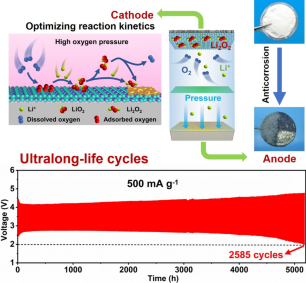
Lithium-oxygen (Li-O2) battery is favored among “beyond lithium-ion” technologies for sustainability because of its exceptional energy density. Major impediments are the poor cycle stability and grievous capacity degradation at high current densities. We address these issues by a “killing two birds with one stone” O2-pressure protocol. It first resolves efficient O2 mass transport at high rates.æ The accelerated reaction kinetics optimizes the composition and growth pathway of discharge products. This protocol secondly achieves protection of Li anodes via densifying corrosion layers on them. Consequently, the battery delivers both ultrahigh discharge capacity (> 9,000 mAh g−1) at 3,000 mA g−1 and excellent cycling stability. Under a dual-strategy effect of high-pressure O2 and artificial protection layers, the battery actualizes over 11-fold increase in cycle life of 5,170 h (2,585 cycles). The strategy opens avenues for advancing Li-O2 batteries towards practical application and confers the extension to other gas-based batteries.
Highlights:
1 An O2− pressure protocol was proposed to strengthen mass transport, accelerate the reaction kinetics and optimize growth pathways of discharge products, which achieves ultrahigh discharge capacity at 3,000 mA g−1 (>9,000 mAh g−1).
2 This general pressure effect can protect Li anodes via densifying corrosion layers on them simultaneously.
3 The breakthrough of continuously operated ultralong-life lithium-oxygen batteries was actualized over a record-high lifetime of ~5,170 h (2,585 cycles) at 500 mA g−1 under constant operation.
Keywords
Download Citation
Endnote/Zotero/Mendeley (RIS)BibTeX
- P.G. Bruce, S.A. Freunberger, L.J. Hardwick, J.-M. Tarascon, Li–O2 and Li–S batteries with high energy storage. Nat. Mater. 11(1), 19–29 (2012). https://doi.org/10.1038/nmat3191
- X. Chi, M. Li, J. Di, P. Bai, L. Song et al., A highly stable and flexible zeolite electrolyte solid-state Li-air battery. Nat. 592(7855), 551–557 (2021). https://doi.org/10.1038/s41586-021-03410-9
- Q. Han, W. Guo, X. He, T. Liu, X. Liu et al., Decoupling mass transport and electron transfer by a double-cathode structure of a Li-O2 battery with high cyclic stability. Joule 6(2), 381–398 (2022). https://doi.org/10.1016/j.joule.2022.01.003
- Z. Lyu, Y. Zhou, W. Dai, X. Cui, M. Lai et al., Recent advances in understanding of the mechanism and control of Li2O2 formation in aprotic Li–O2 batteries. Chem. Soc. Rev. 46(19), 6046–6072 (2017). https://doi.org/10.1039/C7CS00255F
- Z.-Z. Shen, C. Zhou, R. Wen, L.-J. Wan, Surface mechanism of catalytic electrodes in lithium-oxygen batteries: how nanostructures mediate the interfacial reactions. J. Am. Chem. Soc. 142(37), 16007–16015 (2020). https://doi.org/10.1021/jacs.0c07167
- Y. Zhang, S. Zhang, J. Ma, X. Chen, C. Nan et al., Single-atom-mediated spinel octahedral structures for elevated performances of Li-oxygen batteries. Angew. Chem. Int. Ed. 62(15), e202218926 (2023). https://doi.org/10.1002/anie.202218926
- Z. Liang, W. Wang, Y.-C. Lu, The path toward practical Li-air batteries. Joule 6(11), 2458–2473 (2022). https://doi.org/10.1016/j.joule.2022.10.008
- H. Wang, X. Wang, M. Li, L. Zheng, D. Guan et al., Porous materials applied in nonaqueous Li-O2 batteries: status and perspectives. Adv. Mater. 32(44), e2002559 (2020). https://doi.org/10.1002/adma.202002559
- C. Dang, Q. Mu, X. Xie, X. Sun, X. Yang et al., Recent progress in cathode catalyst for nonaqueous lithium oxygen batteries: a review. Adv. Compos. Hybrid Mater. 5(2), 606–626 (2022). https://doi.org/10.1007/s42114-022-00500-8
- Y. Chen, S.A. Freunberger, Z. Peng, O. Fontaine, P.G. Bruce, Charging a Li–O2 battery using a redox mediator. Nat. Chem. 5(6), 489–494 (2013). https://doi.org/10.1038/nchem.1646
- P. Zhang, L. Liu, X. He, X. Liu, H. Wang et al., Promoting surface-mediated oxygen reduction reaction of solid catalysts in metal-O2 batteries by capturing superoxide species. J. Am. Chem. Soc. 141(15), 6263–6270 (2019). https://doi.org/10.1021/jacs.8b13568
- Z. Sun, X. Lin, W. Dou, Y. Tan, A. Hu et al., Redox mediator with the function of intramolecularly disproportionating superoxide intermediate enabled high-performance Li–O2 batteries. Adv. Energy Mater. 12(12), 2270050 (2022). https://doi.org/10.1002/aenm.202270050
- F.S. Gittleson, R.E. Jones, D.K. Ward, M.E. Foster, Oxygen solubility and transport in Li–air battery electrolytes: establishing criteria and strategies for electrolyte design. Energy Environ. Sci. 10(5), 1167–1179 (2017). https://doi.org/10.1039/C6EE02915A
- X.-D. Lin, Y. Gu, X.-R. Shen, W.-W. Wang, Y.-H. Hong et al., An oxygen-blocking oriented multifunctional solid–electrolyte interphase as a protective layer for a lithium metal anode in lithium–oxygen batteries. Energy Environ. Sci. 14(3), 1439–1448 (2021). https://doi.org/10.1039/D0EE02931A
- K. Chen, D.-Y. Yang, G. Huang, X.-B. Zhang, Lithium-air batteries: air-electrochemistry and anode stabilization. Acc. Chem. Res. 54(3), 632–641 (2021). https://doi.org/10.1021/acs.accounts.0c00772
- B. Lu, W. Li, D. Cheng, B. Bhamwala, M. Ceja et al., Suppressing chemical corrosions of lithium metal anodes. Adv. Energy Mater. 12(48), 2202012 (2022). https://doi.org/10.1002/aenm.202202012
- X. Zhang, Q. Zhang, X.-G. Wang, C. Wang, Y.-N. Chen et al., An extremely simple method for protecting lithium anodes in Li-O2 batteries. Angew. Chem. Int. Ed. 57(39), 12814–12818 (2018). https://doi.org/10.1002/anie.201807985
- Y. Zhang, F. Bai, H. Jiang, T. Zhang, A cascade protection strategy from cathode to anode with high air stability for ultralong life Li-air batteries in ambient conditions. Energy Storage Mater. 54, 508–516 (2023). https://doi.org/10.1016/j.ensm.2022.10.040
- M. Asadi, B. Sayahpour, P. Abbasi, A.T. Ngo, K. Karis et al., A lithium-oxygen battery with a long cycle life in an air-like atmosphere. Nat. 555(7697), 502–506 (2018). https://doi.org/10.1038/nature25984
- Y. Ma, P. Qi, J. Ma, L. Wei, L. Zhao et al., Wax-transferred hydrophobic CVD graphene enables water-resistant and dendrite-free lithium anode toward long cycle Li–air battery. Adv. Sci. 8(16), 2100488 (2021). https://doi.org/10.1002/advs.202100488
- H.-S. Lim, W.-J. Kwak, S. Chae, S. Wi, L. Li et al., Stable solid electrolyte interphase layer formed by electrochemical pretreatment of gel polymer coating on Li metal anode for lithium–oxygen batteries. ACS Energy Lett. 6(9), 3321–3331 (2021). https://doi.org/10.1021/acsenergylett.1c01144
- Z. Huang, J. Ren, W. Zhang, M. Xie, Y. Li et al., Protecting the Li-metal anode in a Li-O2 battery by using boric acid as an SEI-forming additive. Adv. Mater. 30(39), e1803270 (2018). https://doi.org/10.1002/adma.201803270
- X.-P. Zhang, Y.-Y. Sun, Z. Sun, C.-S. Yang, T. Zhang, Anode interfacial layer formation via reductive ethyl detaching of organic iodide in lithium-oxygen batteries. Nat. Commun. 10(1), 3543 (2019). https://doi.org/10.1038/s41467-019-11544-8
- Y. Yu, Y.-B. Yin, J.-L. Ma, Z.-W. Chang, T. Sun et al., Designing a self-healing protective film on a lithium metal anode for long-cycle-life lithium-oxygen batteries. Energy Storage Mater. 18, 382–388 (2019). https://doi.org/10.1016/j.ensm.2019.01.009
- C. Fang, B. Lu, G. Pawar, M. Zhang, D. Cheng et al., Pressure-tailored lithium deposition and dissolution in lithium metal batteries. Nat. Energy 6(10), 987–994 (2021). https://doi.org/10.1038/s41560-021-00917-3
- J.M. Costa, A.F. de Almeida Neto, Ag–Co electrocatalysts for rechargeable Lithium–O2 batteries: O2 pressure and current density effects. Electrocatalysis 10(5), 532–539 (2019). https://doi.org/10.1007/s12678-019-00540-7
- H.J. Kwon, H.C. Lee, J. Ko, I.S. Jung, H.C. Lee et al., Effects of oxygen partial pressure on Li-air battery performance. J. Power. Sources 364, 280–287 (2017). https://doi.org/10.1016/j.jpowsour.2017.08.052
- S.S. Sandhu, J.P. Fellner, G.W. Brutchen, Diffusion-limited model for a lithium/air battery with an organic electrolyte. J. Power. Sources 164(1), 365–371 (2007). https://doi.org/10.1016/j.jpowsour.2006.09.099
- B.A.B. Francisco, J.P.O. Júlio, C.G. Anchieta, T.C.M. Nepel, R.M. Filho et al., Systematic study of O2 supply in Li–O2 batteries with high and low doner number solvents. ACS Appl. Energy Mater. 6(10), 5167–5176 (2023). https://doi.org/10.1021/acsaem.3c00057
- F. Xiao, Q. Bao, C. Sun, Y. Li, D. Cui et al., D-band center regulation for durable catalysts and constructing a robust hybrid layer on Li anode enable long-life Li-O2 batteries. Adv. Energy Mater. 14(15), 2303766 (2024). https://doi.org/10.1002/aenm.202303766
- D. Geng, N. Ding, T.S.A. Hor, S.W. Chien, Z. Liu et al., From lithium-oxygen to lithium-air batteries: challenges and opportunities. Adv. Energy Mater. 6(9), 1502164 (2016). https://doi.org/10.1002/aenm.201502164
- J.-Q. Cai, H.-J. Luo, X.-M. Tao, M.-Q. Tan, Initial subsurface incorporation of oxygen into Ru(0001): a density functional theory study. ChemPhysChem 16(18), 3937–3948 (2015). https://doi.org/10.1002/cphc.201500681
- G. Zhang, G. Li, J. Wang, H. Tong, J. Wang et al., 2D SnSe cathode catalyst featuring an efficient facet-dependent selective Li2O2 growth/decomposition for Li–oxygen batteries. Adv. Energy Mater. 12(21), 2103910 (2022). https://doi.org/10.1002/aenm.202103910
- J. Lu, Y.J. Lee, X. Luo, K.C. Lau, M. Asadi et al., A lithium–oxygen battery based on lithium superoxide. Nat. 529(7586), 377–382 (2016). https://doi.org/10.1038/nature16484
References
P.G. Bruce, S.A. Freunberger, L.J. Hardwick, J.-M. Tarascon, Li–O2 and Li–S batteries with high energy storage. Nat. Mater. 11(1), 19–29 (2012). https://doi.org/10.1038/nmat3191
X. Chi, M. Li, J. Di, P. Bai, L. Song et al., A highly stable and flexible zeolite electrolyte solid-state Li-air battery. Nat. 592(7855), 551–557 (2021). https://doi.org/10.1038/s41586-021-03410-9
Q. Han, W. Guo, X. He, T. Liu, X. Liu et al., Decoupling mass transport and electron transfer by a double-cathode structure of a Li-O2 battery with high cyclic stability. Joule 6(2), 381–398 (2022). https://doi.org/10.1016/j.joule.2022.01.003
Z. Lyu, Y. Zhou, W. Dai, X. Cui, M. Lai et al., Recent advances in understanding of the mechanism and control of Li2O2 formation in aprotic Li–O2 batteries. Chem. Soc. Rev. 46(19), 6046–6072 (2017). https://doi.org/10.1039/C7CS00255F
Z.-Z. Shen, C. Zhou, R. Wen, L.-J. Wan, Surface mechanism of catalytic electrodes in lithium-oxygen batteries: how nanostructures mediate the interfacial reactions. J. Am. Chem. Soc. 142(37), 16007–16015 (2020). https://doi.org/10.1021/jacs.0c07167
Y. Zhang, S. Zhang, J. Ma, X. Chen, C. Nan et al., Single-atom-mediated spinel octahedral structures for elevated performances of Li-oxygen batteries. Angew. Chem. Int. Ed. 62(15), e202218926 (2023). https://doi.org/10.1002/anie.202218926
Z. Liang, W. Wang, Y.-C. Lu, The path toward practical Li-air batteries. Joule 6(11), 2458–2473 (2022). https://doi.org/10.1016/j.joule.2022.10.008
H. Wang, X. Wang, M. Li, L. Zheng, D. Guan et al., Porous materials applied in nonaqueous Li-O2 batteries: status and perspectives. Adv. Mater. 32(44), e2002559 (2020). https://doi.org/10.1002/adma.202002559
C. Dang, Q. Mu, X. Xie, X. Sun, X. Yang et al., Recent progress in cathode catalyst for nonaqueous lithium oxygen batteries: a review. Adv. Compos. Hybrid Mater. 5(2), 606–626 (2022). https://doi.org/10.1007/s42114-022-00500-8
Y. Chen, S.A. Freunberger, Z. Peng, O. Fontaine, P.G. Bruce, Charging a Li–O2 battery using a redox mediator. Nat. Chem. 5(6), 489–494 (2013). https://doi.org/10.1038/nchem.1646
P. Zhang, L. Liu, X. He, X. Liu, H. Wang et al., Promoting surface-mediated oxygen reduction reaction of solid catalysts in metal-O2 batteries by capturing superoxide species. J. Am. Chem. Soc. 141(15), 6263–6270 (2019). https://doi.org/10.1021/jacs.8b13568
Z. Sun, X. Lin, W. Dou, Y. Tan, A. Hu et al., Redox mediator with the function of intramolecularly disproportionating superoxide intermediate enabled high-performance Li–O2 batteries. Adv. Energy Mater. 12(12), 2270050 (2022). https://doi.org/10.1002/aenm.202270050
F.S. Gittleson, R.E. Jones, D.K. Ward, M.E. Foster, Oxygen solubility and transport in Li–air battery electrolytes: establishing criteria and strategies for electrolyte design. Energy Environ. Sci. 10(5), 1167–1179 (2017). https://doi.org/10.1039/C6EE02915A
X.-D. Lin, Y. Gu, X.-R. Shen, W.-W. Wang, Y.-H. Hong et al., An oxygen-blocking oriented multifunctional solid–electrolyte interphase as a protective layer for a lithium metal anode in lithium–oxygen batteries. Energy Environ. Sci. 14(3), 1439–1448 (2021). https://doi.org/10.1039/D0EE02931A
K. Chen, D.-Y. Yang, G. Huang, X.-B. Zhang, Lithium-air batteries: air-electrochemistry and anode stabilization. Acc. Chem. Res. 54(3), 632–641 (2021). https://doi.org/10.1021/acs.accounts.0c00772
B. Lu, W. Li, D. Cheng, B. Bhamwala, M. Ceja et al., Suppressing chemical corrosions of lithium metal anodes. Adv. Energy Mater. 12(48), 2202012 (2022). https://doi.org/10.1002/aenm.202202012
X. Zhang, Q. Zhang, X.-G. Wang, C. Wang, Y.-N. Chen et al., An extremely simple method for protecting lithium anodes in Li-O2 batteries. Angew. Chem. Int. Ed. 57(39), 12814–12818 (2018). https://doi.org/10.1002/anie.201807985
Y. Zhang, F. Bai, H. Jiang, T. Zhang, A cascade protection strategy from cathode to anode with high air stability for ultralong life Li-air batteries in ambient conditions. Energy Storage Mater. 54, 508–516 (2023). https://doi.org/10.1016/j.ensm.2022.10.040
M. Asadi, B. Sayahpour, P. Abbasi, A.T. Ngo, K. Karis et al., A lithium-oxygen battery with a long cycle life in an air-like atmosphere. Nat. 555(7697), 502–506 (2018). https://doi.org/10.1038/nature25984
Y. Ma, P. Qi, J. Ma, L. Wei, L. Zhao et al., Wax-transferred hydrophobic CVD graphene enables water-resistant and dendrite-free lithium anode toward long cycle Li–air battery. Adv. Sci. 8(16), 2100488 (2021). https://doi.org/10.1002/advs.202100488
H.-S. Lim, W.-J. Kwak, S. Chae, S. Wi, L. Li et al., Stable solid electrolyte interphase layer formed by electrochemical pretreatment of gel polymer coating on Li metal anode for lithium–oxygen batteries. ACS Energy Lett. 6(9), 3321–3331 (2021). https://doi.org/10.1021/acsenergylett.1c01144
Z. Huang, J. Ren, W. Zhang, M. Xie, Y. Li et al., Protecting the Li-metal anode in a Li-O2 battery by using boric acid as an SEI-forming additive. Adv. Mater. 30(39), e1803270 (2018). https://doi.org/10.1002/adma.201803270
X.-P. Zhang, Y.-Y. Sun, Z. Sun, C.-S. Yang, T. Zhang, Anode interfacial layer formation via reductive ethyl detaching of organic iodide in lithium-oxygen batteries. Nat. Commun. 10(1), 3543 (2019). https://doi.org/10.1038/s41467-019-11544-8
Y. Yu, Y.-B. Yin, J.-L. Ma, Z.-W. Chang, T. Sun et al., Designing a self-healing protective film on a lithium metal anode for long-cycle-life lithium-oxygen batteries. Energy Storage Mater. 18, 382–388 (2019). https://doi.org/10.1016/j.ensm.2019.01.009
C. Fang, B. Lu, G. Pawar, M. Zhang, D. Cheng et al., Pressure-tailored lithium deposition and dissolution in lithium metal batteries. Nat. Energy 6(10), 987–994 (2021). https://doi.org/10.1038/s41560-021-00917-3
J.M. Costa, A.F. de Almeida Neto, Ag–Co electrocatalysts for rechargeable Lithium–O2 batteries: O2 pressure and current density effects. Electrocatalysis 10(5), 532–539 (2019). https://doi.org/10.1007/s12678-019-00540-7
H.J. Kwon, H.C. Lee, J. Ko, I.S. Jung, H.C. Lee et al., Effects of oxygen partial pressure on Li-air battery performance. J. Power. Sources 364, 280–287 (2017). https://doi.org/10.1016/j.jpowsour.2017.08.052
S.S. Sandhu, J.P. Fellner, G.W. Brutchen, Diffusion-limited model for a lithium/air battery with an organic electrolyte. J. Power. Sources 164(1), 365–371 (2007). https://doi.org/10.1016/j.jpowsour.2006.09.099
B.A.B. Francisco, J.P.O. Júlio, C.G. Anchieta, T.C.M. Nepel, R.M. Filho et al., Systematic study of O2 supply in Li–O2 batteries with high and low doner number solvents. ACS Appl. Energy Mater. 6(10), 5167–5176 (2023). https://doi.org/10.1021/acsaem.3c00057
F. Xiao, Q. Bao, C. Sun, Y. Li, D. Cui et al., D-band center regulation for durable catalysts and constructing a robust hybrid layer on Li anode enable long-life Li-O2 batteries. Adv. Energy Mater. 14(15), 2303766 (2024). https://doi.org/10.1002/aenm.202303766
D. Geng, N. Ding, T.S.A. Hor, S.W. Chien, Z. Liu et al., From lithium-oxygen to lithium-air batteries: challenges and opportunities. Adv. Energy Mater. 6(9), 1502164 (2016). https://doi.org/10.1002/aenm.201502164
J.-Q. Cai, H.-J. Luo, X.-M. Tao, M.-Q. Tan, Initial subsurface incorporation of oxygen into Ru(0001): a density functional theory study. ChemPhysChem 16(18), 3937–3948 (2015). https://doi.org/10.1002/cphc.201500681
G. Zhang, G. Li, J. Wang, H. Tong, J. Wang et al., 2D SnSe cathode catalyst featuring an efficient facet-dependent selective Li2O2 growth/decomposition for Li–oxygen batteries. Adv. Energy Mater. 12(21), 2103910 (2022). https://doi.org/10.1002/aenm.202103910
J. Lu, Y.J. Lee, X. Luo, K.C. Lau, M. Asadi et al., A lithium–oxygen battery based on lithium superoxide. Nat. 529(7586), 377–382 (2016). https://doi.org/10.1038/nature16484