
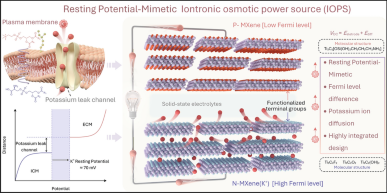
Resting-Potential-Inspired Solid-State Iontronic Osmotic Power Source Enabled by Polarized MXene

Corresponding Author: Nishuang Liu
Nano-Micro Letters,
Vol. 18 (2026), Article Number: 449
Abstract
Bio-inspired osmotic energy has shown great potential as a portable energy source or artificial electrical organ for green and sustainable power generation. However, ion-electron decoupling problem and complex structures resulting from over-engineering often limit output power and portability. Here, we propose a comprehensive design strategy that exploits the unique ion-electron coupling properties of polarized MXene to mimic transmembrane ion transport at resting potential, thereby developing an all-MXene solid-state iontronics osmotic power source (IOPS). Density functional theory calculations and multiscale characterizations reveal that its operating mechanism is based on the diffusion dynamics of K+ under a concentration gradient and the Fermi level difference between two polarized MXene electrodes. The device achieves an initial open-circuit voltage exceeding 0.57 V and a high volumetric power density of 1030 μW cm−3. The highly integrated architecture of the IOPS module allows for straightforward scalability and reconfiguration to power commercial electronic devices. This work integrates the principles of biological ion gradients with emerging iontronics, providing a solid-state iontronic design strategy for compact osmotic power source. Here, taking the natural resting potential as a design blueprint, we report a solid-state iontronic osmotic energy generator, termed IOPS, which fully leverages the ion–electron coupling effect in polarized MXene. Its mechanism arises from the diffusion kinetics of K+ under an ion gradient and the Fermi level difference between two distinct polarized MXenes at the positive and negative electrodes. An initial open-circuit voltage exceeding 0.57 V and a high volumetric power density of 1030 μW cm-3 were achieved. This work integrates the fundamental principles of biological ion gradients with emerging iontronics technology, offering a paradigm for the practical deployment of osmotic energy.
Highlights:
1 The solid-state architecture of iontronics osmotic power source (IOPS) significantly enhances volumetric power density and eliminates risks associated with leakage and drying up.
2 By making deep use of the ion-electron coupling properties of MXene, the highly integrated electrode design enables the IOPS device to be assembled into a compact osmotic power source using only three building blocks.
3 IOPS arrays can efficiently power commercial electronic devices and show great potential in portable, responsive power systems.
Keywords
Download Citation
Endnote/Zotero/Mendeley (RIS)BibTeX
- B. Coste, J. Mathur, M. Schmidt, T.J. Earley, S. Ranade et al., Piezo1 and Piezo2 are essential components of distinct mechanically activated cation channels. Science 330(6000), 55–60 (2010). https://doi.org/10.1126/science.1193270
- B. Coste, B. Xiao, J.S. Santos, R. Syeda, J. Grandl et al., Piezo proteins are pore-forming subunits of mechanically activated channels. Nature 483(7388), 176–181 (2012). https://doi.org/10.1038/nature10812
- Y. Hou, X. Hou, Bioinspired nanofluidic iontronics. Science 373(6555), 628–629 (2021). https://doi.org/10.1126/science.abj0437
- M. Deng, Z. Ren, J. Yin, X. Zhou, L. Wang et al., A constructive perspective on ionic self-powered pressure sensing. Prog. Mater. Sci. 157, 101595 (2026). https://doi.org/10.1016/j.pmatsci.2025.101595
- S.Z. Bisri, S. Shimizu, M. Nakano, Y. Iwasa, Endeavor of iontronics: from fundamentals to applications of ion-controlled electronics. Adv. Mater. 29(25), 1607054 (2017). https://doi.org/10.1002/adma.201607054
- H. Qian, D. Wei, Z. Wang, Bionic iontronics based on nano-confined structures. Nano Res. 16(9), 11718–11730 (2023). https://doi.org/10.1007/s12274-023-5705-z
- J. Yin, P. Jia, Z. Ren, Q. Zhang, W. Lu et al., Mechanically enhanced, environmentally stable, and bioinspired charge-gradient hydrogel membranes for efficient ion gradient power generation and linear self-powered sensing. Adv. Mater. 37(24), 2417944 (2025). https://doi.org/10.1002/adma.202417944
- Q. Zhang, Z. Ren, P. Jia, J. Shi, J. Yin et al., An ultra-miniaturized fiber humidity sensor based on near-parallel ion pathways induced efficient water−electricity conversion. Adv. Mater. 37(3), 2411558 (2025). https://doi.org/10.1002/adma.202411558
- Z. Zhang, L. Wen, L. Jiang, Nanofluidics for osmotic energy conversion. Nat. Rev. Mater. 6(7), 622–639 (2021). https://doi.org/10.1038/s41578-021-00300-4
- A. Siria, P. Poncharal, A.-L. Biance, R. Fulcrand, X. Blase et al., Giant osmotic energy conversion measured in a single transmembrane boron nitride nanotube. Nature 494(7438), 455–458 (2013). https://doi.org/10.1038/nature11876
- J. Lu, H. Xu, H. Yu, X. Hu, J. Xia et al., Ultrafast rectifying counter-directional transport of proton and metal ions in metal-organic framework–based nanochannels. Sci. Adv. 8(14), eabl5070 (2022). https://doi.org/10.1126/sciadv.abl5070
- L. Yang, F. Yang, X. Liu, K. Li, Y. Zhou et al., A moisture-enabled fully printable power source inspired by electric eels. Proc. Natl. Acad. Sci. U. S. A. 118(16), e2023164118 (2021). https://doi.org/10.1073/pnas.2023164118
- Y. Wang, T. Guo, Z. Tian, K. Bibi, Y.-Z. Zhang et al., MXenes for energy harvesting. Adv. Mater. 34(21), 2108560 (2022). https://doi.org/10.1002/adma.202108560
- H. Tao, Q. Fan, T. Ma, S. Liu, H. Gysling et al., Two-dimensional materials for energy conversion and storage. Prog. Mater. Sci. 111, 100637 (2020). https://doi.org/10.1016/j.pmatsci.2020.100637
- J. Peng, Z.-J. Chen, B. Ding, H.-M. Cheng, Recent advances for the synthesis and applications of 2-dimensional ternary layered materials. Research 6, 0040 (2023). https://doi.org/10.34133/research.0040
- Z. Ren, Q. Zhang, J. Yin, M. Deng, X. Zhou et al., Spatial decoupling strategy enhanced ionic liquid-confined porous MXene for breakthrough osmotic energy conversion. Adv. Mater. 38(5), e14029 (2026). https://doi.org/10.1002/adma.202514029
- T.B.H. Schroeder, A. Guha, A. Lamoureux, G. VanRenterghem, D. Sept et al., An electric-eel-inspired soft power source from stacked hydrogels. Nature 552(7684), 214–218 (2017). https://doi.org/10.1038/nature24670
- Y. Zhang, J. Riexinger, X. Yang, E. Mikhailova, Y. Jin et al., A microscale soft ionic power source modulates neuronal network activity. Nature 620(7976), 1001–1006 (2023). https://doi.org/10.1038/s41586-023-06295-y
- Y. Zhang, T. Sun, X. Yang, L. Zhou, C.M.J. Tan et al., A microscale soft lithium-ion battery for tissue stimulation. Nat. Chem. Eng. 1(11), 691–701 (2024). https://doi.org/10.1038/s44286-024-00136-z
- Z. Ren, Q. Zhang, J. Yin, P. Jia, W. Lu et al., Enhancing osmotic energy harvesting through supramolecular design of oxygen-functionalized MXene with biomimetic ion channels. Adv. Funct. Mater. 34(44), 2404410 (2024). https://doi.org/10.1002/adfm.202404410
- C. Chen, D. Liu, L. He, S. Qin, J. Wang et al., Bio-inspired nanocomposite membranes for osmotic energy harvesting. Joule 4(1), 247–261 (2020). https://doi.org/10.1016/j.joule.2019.11.010
- F. Yang, P. Peng, Z.-Y. Yan, H. Fan, X. Li et al., Vertical iontronic energy storage based on osmotic effects and electrode redox reactions. Nat. Energy 9(3), 263–271 (2024). https://doi.org/10.1038/s41560-023-01431-4
- D.A. Doyle, J.M. Cabral, R.A. Pfuetzner, A. Kuo, J.M. Gulbis et al., The structure of the potassium channel: molecular basis of K+conduction and selectivity. Science 280(5360), 69–77 (1998). https://doi.org/10.1126/science.280.5360.69
- S.A.N. Goldstein, D. Bockenhauer, I. O’Kelly, N. Zilberberg, Potassium leak channels and the KCNK family of two-p-domain subunits. Nat. Rev. Neurosci. 2(3), 175–184 (2001). https://doi.org/10.1038/35058574
- X.-Y. Li, H. Toyoda, Role of leak potassium channels in pain signaling. Brain Res. Bull. 119, 73–79 (2015). https://doi.org/10.1016/j.brainresbull.2015.08.007
- K. Yoshida, S. Shi, M. Ukai-Tadenuma, H. Fujishima, R.-I. Ohno et al., Leak potassium channels regulate sleep duration. Proc. Natl. Acad. Sci. USA. 115(40), E9459–E9468 (2018). https://doi.org/10.1073/pnas.1806486115
- D. Schmidt, Q.-X. Jiang, R. MacKinnon, Phospholipids and the origin of cationic gating charges in voltage sensors. Nature 444(7120), 775–779 (2006). https://doi.org/10.1038/nature05416
- P.A.M. Schmidpeter, J.T. Petroff, L. Khajoueinejad, A. Wague, C. Frankfater et al., Membrane phospholipids control gating of the mechanosensitive potassium leak channel TREK1. Nat. Commun. 14, 1077 (2023). https://doi.org/10.1038/s41467-023-36765-w
- D. Lei, Z. Zhang, L. Jiang, Bioinspired 2D nanofluidic membranes for energy applications. Chem. Soc. Rev. 53(5), 2300–2325 (2024). https://doi.org/10.1039/d3cs00382e
- Y. Wei, P. Zhang, R.A. Soomro, Q. Zhu, B. Xu, Advances in the synthesis of 2D MXenes. Adv. Mater. 33(39), 2103148 (2021). https://doi.org/10.1002/adma.202103148
- X. Hu, Q. Fan, S. Wang, Y. Chen, D. Wang et al., Two-dimensional MXenes: innovative materials for efficient thermal management and safety solutions. Research 7, 0542 (2024). https://doi.org/10.34133/research.0542
- A. Guha, T.J. Kalkus, T.B.H. Schroeder, O.G. Willis, C. Rader et al., Powering electronic devices from salt gradients in AA-battery-sized stacks of hydrogel-infused paper. Adv. Mater. 33(31), 2101757 (2021). https://doi.org/10.1002/adma.202101757
- Y. An, Y. Tian, H. Shen, Q. Man, S. Xiong et al., Two-dimensional MXenes for flexible energy storage devices. Energy Environ. Sci. 16(10), 4191–4250 (2023). https://doi.org/10.1039/d3ee01841e
- X. He, Y. Ni, Y. Li, H. Sun, Y. Lu et al., An MXene-based metal anode with stepped sodiophilic gradient structure enables a large current density for rechargeable Na–O2 batteries. Adv. Mater. 34(15), 2106565 (2022). https://doi.org/10.1002/adma.202106565
- S. Zhao, Z. Liu, G. Xie, X. Guo, Z. Guo et al., Achieving high-performance 3D K+-pre-intercalated Ti3C2Tx MXene for potassium-ion hybrid capacitors via regulating electrolyte solvation structure. Angew. Chem. Int. Ed. 60(50), 26246–26253 (2021). https://doi.org/10.1002/anie.202112090
- H. Riazi, M. Anayee, K. Hantanasirisakul, A.A. Shamsabadi, B. Anasori et al., Surface modification of a MXene by an aminosilane coupling agent. Adv. Mater. Interfaces 7(6), 1902008 (2020). https://doi.org/10.1002/admi.201902008
- L. Xiong, Y. Wei, C. Chen, X. Chen, Q. Fu et al., Thin lamellar films with enhanced mechanical properties for durable radiative cooling. Nat. Commun. 14, 6129 (2023). https://doi.org/10.1038/s41467-023-41797-3
- O. Nordness, J.F. Brennecke, Ion dissociation in ionic liquids and ionic liquid solutions. Chem. Rev. 120(23), 12873–12902 (2020). https://doi.org/10.1021/acs.chemrev.0c00373
- S. Han, P. Wen, H. Wang, Y. Zhou, Y. Gu et al., Sequencing polymers to enable solid-state lithium batteries. Nat. Mater. 22(12), 1515–1522 (2023). https://doi.org/10.1038/s41563-023-01693-z
- C.E. Owens, J. Du, P.B. Sánchez, Understanding the dynamics of cellulose dissolved in an ionic liquid solvent under shear and extensional flows. Biomacromol 23(5), 1958–1969 (2022). https://doi.org/10.1021/acs.biomac.1c01623
- X. Zhao, Z. Fu, X. Zhang, X. Wang, B. Li et al., More is better: high-entropy electrolyte design in rechargeable batteries. Energy Environ. Sci. 17(7), 2406–2430 (2024). https://doi.org/10.1039/d3ee03821a
- R. Yang, L. Mei, Z. Lin, Y. Fan, J. Lim et al., Intercalation in 2D materials and in situ studies. Nat. Rev. Chem. 8(6), 410–432 (2024). https://doi.org/10.1038/s41570-024-00605-2
- X. Liu, T. Ueki, H. Gao, T.L. Woodard, K.P. Nevin et al., Microbial biofilms for electricity generation from water evaporation and power to wearables. Nat. Commun. 13, 4369 (2022). https://doi.org/10.1038/s41467-022-32105-6
- W.B. Han, D.-J. Kim, Y.M. Kim, G.-J. Ko, J.-W. Shin et al., Electric eel-inspired soft electrocytes for solid-state power systems. Adv. Funct. Mater. 34(2), 2309781 (2024). https://doi.org/10.1002/adfm.202309781
- N. He, H. Wang, F. Li, B. Jiang, D. Tang et al., Ion engines in hydrogels boosting hydrovoltaic electricity generation. Energy Environ. Sci. 16(6), 2494–2504 (2023). https://doi.org/10.1039/d2ee03621e
- Y. Zhang, T. Yang, K. Shang, F. Guo, Y. Shang et al., Sustainable power generation for at least one month from ambient humidity using unique nanofluidic diode. Nat. Commun. 13, 3484 (2022). https://doi.org/10.1038/s41467-022-31067-z
- H. Xia, W. Zhou, X. Qu, W. Wang, X. Wang et al., Electricity generated by upstream proton diffusion in two-dimensional nanochannels. Nat. Nanotechnol. 19(9), 1316–1322 (2024). https://doi.org/10.1038/s41565-024-01691-5
- C. Zhu, P. Liu, B. Niu, Y. Liu, W. Xin et al., Metallic two-dimensional MoS2 composites as high-performance osmotic energy conversion membranes. J. Am. Chem. Soc. 143(4), 1932–1940 (2021). https://doi.org/10.1021/jacs.0c11251
- J. Yin, J. Zhou, S. Fang, W. Guo, Hydrovoltaic energy on the way. Joule 4(9), 1852–1855 (2020). https://doi.org/10.1016/j.joule.2020.07.015
- X. Liu, H. Gao, J.E. Ward, X. Liu, B. Yin et al., Power generation from ambient humidity using protein nanowires. Nature 578(7796), 550–554 (2020). https://doi.org/10.1038/s41586-020-2010-9
- Q. Hu, X. Lin, G. Ren, J. Lü, W. Wang et al., Hydrovoltaic electricity generation induced by living leaf transpiration. Nat. Water 2(10), 988–998 (2024). https://doi.org/10.1038/s44221-024-00311-9
- L.S.C. Pingree, O.G. Reid, D.S. Ginger, Electrical scanning probe microscopy on active organic electronic devices. Adv. Mater. 21(1), 19–28 (2009). https://doi.org/10.1002/adma.200801466
- W. Melitz, J. Shen, A.C. Kummel, S. Lee, Kelvin probe force microscopy and its application. Surf. Sci. Rep. 66(1), 1–27 (2011). https://doi.org/10.1016/j.surfrep.2010.10.001
- X. Li, Z. Huang, C.E. Shuck, G. Liang, Y. Gogotsi et al., MXene chemistry, electrochemistry and energy storage applications. Nat. Rev. Chem. 6(6), 389–404 (2022). https://doi.org/10.1038/s41570-022-00384-8
- J. Holoubek, H. Liu, Z. Wu, Y. Yin, X. Xing et al., Tailoring electrolyte solvation for Li metal batteries cycled at ultra-low temperature. Nat. Energy 6(3), 303–313 (2021). https://doi.org/10.1038/s41560-021-00783-z
- J. Li, Z. Hu, S. Zhang, H. Zhang, S. Guo et al., Molecular engineering of renewable cellulose biopolymers for solid-state battery electrolytes. Nat. Sustain. 7(11), 1481–1491 (2024). https://doi.org/10.1038/s41893-024-01414-7
References
B. Coste, J. Mathur, M. Schmidt, T.J. Earley, S. Ranade et al., Piezo1 and Piezo2 are essential components of distinct mechanically activated cation channels. Science 330(6000), 55–60 (2010). https://doi.org/10.1126/science.1193270
B. Coste, B. Xiao, J.S. Santos, R. Syeda, J. Grandl et al., Piezo proteins are pore-forming subunits of mechanically activated channels. Nature 483(7388), 176–181 (2012). https://doi.org/10.1038/nature10812
Y. Hou, X. Hou, Bioinspired nanofluidic iontronics. Science 373(6555), 628–629 (2021). https://doi.org/10.1126/science.abj0437
M. Deng, Z. Ren, J. Yin, X. Zhou, L. Wang et al., A constructive perspective on ionic self-powered pressure sensing. Prog. Mater. Sci. 157, 101595 (2026). https://doi.org/10.1016/j.pmatsci.2025.101595
S.Z. Bisri, S. Shimizu, M. Nakano, Y. Iwasa, Endeavor of iontronics: from fundamentals to applications of ion-controlled electronics. Adv. Mater. 29(25), 1607054 (2017). https://doi.org/10.1002/adma.201607054
H. Qian, D. Wei, Z. Wang, Bionic iontronics based on nano-confined structures. Nano Res. 16(9), 11718–11730 (2023). https://doi.org/10.1007/s12274-023-5705-z
J. Yin, P. Jia, Z. Ren, Q. Zhang, W. Lu et al., Mechanically enhanced, environmentally stable, and bioinspired charge-gradient hydrogel membranes for efficient ion gradient power generation and linear self-powered sensing. Adv. Mater. 37(24), 2417944 (2025). https://doi.org/10.1002/adma.202417944
Q. Zhang, Z. Ren, P. Jia, J. Shi, J. Yin et al., An ultra-miniaturized fiber humidity sensor based on near-parallel ion pathways induced efficient water−electricity conversion. Adv. Mater. 37(3), 2411558 (2025). https://doi.org/10.1002/adma.202411558
Z. Zhang, L. Wen, L. Jiang, Nanofluidics for osmotic energy conversion. Nat. Rev. Mater. 6(7), 622–639 (2021). https://doi.org/10.1038/s41578-021-00300-4
A. Siria, P. Poncharal, A.-L. Biance, R. Fulcrand, X. Blase et al., Giant osmotic energy conversion measured in a single transmembrane boron nitride nanotube. Nature 494(7438), 455–458 (2013). https://doi.org/10.1038/nature11876
J. Lu, H. Xu, H. Yu, X. Hu, J. Xia et al., Ultrafast rectifying counter-directional transport of proton and metal ions in metal-organic framework–based nanochannels. Sci. Adv. 8(14), eabl5070 (2022). https://doi.org/10.1126/sciadv.abl5070
L. Yang, F. Yang, X. Liu, K. Li, Y. Zhou et al., A moisture-enabled fully printable power source inspired by electric eels. Proc. Natl. Acad. Sci. U. S. A. 118(16), e2023164118 (2021). https://doi.org/10.1073/pnas.2023164118
Y. Wang, T. Guo, Z. Tian, K. Bibi, Y.-Z. Zhang et al., MXenes for energy harvesting. Adv. Mater. 34(21), 2108560 (2022). https://doi.org/10.1002/adma.202108560
H. Tao, Q. Fan, T. Ma, S. Liu, H. Gysling et al., Two-dimensional materials for energy conversion and storage. Prog. Mater. Sci. 111, 100637 (2020). https://doi.org/10.1016/j.pmatsci.2020.100637
J. Peng, Z.-J. Chen, B. Ding, H.-M. Cheng, Recent advances for the synthesis and applications of 2-dimensional ternary layered materials. Research 6, 0040 (2023). https://doi.org/10.34133/research.0040
Z. Ren, Q. Zhang, J. Yin, M. Deng, X. Zhou et al., Spatial decoupling strategy enhanced ionic liquid-confined porous MXene for breakthrough osmotic energy conversion. Adv. Mater. 38(5), e14029 (2026). https://doi.org/10.1002/adma.202514029
T.B.H. Schroeder, A. Guha, A. Lamoureux, G. VanRenterghem, D. Sept et al., An electric-eel-inspired soft power source from stacked hydrogels. Nature 552(7684), 214–218 (2017). https://doi.org/10.1038/nature24670
Y. Zhang, J. Riexinger, X. Yang, E. Mikhailova, Y. Jin et al., A microscale soft ionic power source modulates neuronal network activity. Nature 620(7976), 1001–1006 (2023). https://doi.org/10.1038/s41586-023-06295-y
Y. Zhang, T. Sun, X. Yang, L. Zhou, C.M.J. Tan et al., A microscale soft lithium-ion battery for tissue stimulation. Nat. Chem. Eng. 1(11), 691–701 (2024). https://doi.org/10.1038/s44286-024-00136-z
Z. Ren, Q. Zhang, J. Yin, P. Jia, W. Lu et al., Enhancing osmotic energy harvesting through supramolecular design of oxygen-functionalized MXene with biomimetic ion channels. Adv. Funct. Mater. 34(44), 2404410 (2024). https://doi.org/10.1002/adfm.202404410
C. Chen, D. Liu, L. He, S. Qin, J. Wang et al., Bio-inspired nanocomposite membranes for osmotic energy harvesting. Joule 4(1), 247–261 (2020). https://doi.org/10.1016/j.joule.2019.11.010
F. Yang, P. Peng, Z.-Y. Yan, H. Fan, X. Li et al., Vertical iontronic energy storage based on osmotic effects and electrode redox reactions. Nat. Energy 9(3), 263–271 (2024). https://doi.org/10.1038/s41560-023-01431-4
D.A. Doyle, J.M. Cabral, R.A. Pfuetzner, A. Kuo, J.M. Gulbis et al., The structure of the potassium channel: molecular basis of K+conduction and selectivity. Science 280(5360), 69–77 (1998). https://doi.org/10.1126/science.280.5360.69
S.A.N. Goldstein, D. Bockenhauer, I. O’Kelly, N. Zilberberg, Potassium leak channels and the KCNK family of two-p-domain subunits. Nat. Rev. Neurosci. 2(3), 175–184 (2001). https://doi.org/10.1038/35058574
X.-Y. Li, H. Toyoda, Role of leak potassium channels in pain signaling. Brain Res. Bull. 119, 73–79 (2015). https://doi.org/10.1016/j.brainresbull.2015.08.007
K. Yoshida, S. Shi, M. Ukai-Tadenuma, H. Fujishima, R.-I. Ohno et al., Leak potassium channels regulate sleep duration. Proc. Natl. Acad. Sci. USA. 115(40), E9459–E9468 (2018). https://doi.org/10.1073/pnas.1806486115
D. Schmidt, Q.-X. Jiang, R. MacKinnon, Phospholipids and the origin of cationic gating charges in voltage sensors. Nature 444(7120), 775–779 (2006). https://doi.org/10.1038/nature05416
P.A.M. Schmidpeter, J.T. Petroff, L. Khajoueinejad, A. Wague, C. Frankfater et al., Membrane phospholipids control gating of the mechanosensitive potassium leak channel TREK1. Nat. Commun. 14, 1077 (2023). https://doi.org/10.1038/s41467-023-36765-w
D. Lei, Z. Zhang, L. Jiang, Bioinspired 2D nanofluidic membranes for energy applications. Chem. Soc. Rev. 53(5), 2300–2325 (2024). https://doi.org/10.1039/d3cs00382e
Y. Wei, P. Zhang, R.A. Soomro, Q. Zhu, B. Xu, Advances in the synthesis of 2D MXenes. Adv. Mater. 33(39), 2103148 (2021). https://doi.org/10.1002/adma.202103148
X. Hu, Q. Fan, S. Wang, Y. Chen, D. Wang et al., Two-dimensional MXenes: innovative materials for efficient thermal management and safety solutions. Research 7, 0542 (2024). https://doi.org/10.34133/research.0542
A. Guha, T.J. Kalkus, T.B.H. Schroeder, O.G. Willis, C. Rader et al., Powering electronic devices from salt gradients in AA-battery-sized stacks of hydrogel-infused paper. Adv. Mater. 33(31), 2101757 (2021). https://doi.org/10.1002/adma.202101757
Y. An, Y. Tian, H. Shen, Q. Man, S. Xiong et al., Two-dimensional MXenes for flexible energy storage devices. Energy Environ. Sci. 16(10), 4191–4250 (2023). https://doi.org/10.1039/d3ee01841e
X. He, Y. Ni, Y. Li, H. Sun, Y. Lu et al., An MXene-based metal anode with stepped sodiophilic gradient structure enables a large current density for rechargeable Na–O2 batteries. Adv. Mater. 34(15), 2106565 (2022). https://doi.org/10.1002/adma.202106565
S. Zhao, Z. Liu, G. Xie, X. Guo, Z. Guo et al., Achieving high-performance 3D K+-pre-intercalated Ti3C2Tx MXene for potassium-ion hybrid capacitors via regulating electrolyte solvation structure. Angew. Chem. Int. Ed. 60(50), 26246–26253 (2021). https://doi.org/10.1002/anie.202112090
H. Riazi, M. Anayee, K. Hantanasirisakul, A.A. Shamsabadi, B. Anasori et al., Surface modification of a MXene by an aminosilane coupling agent. Adv. Mater. Interfaces 7(6), 1902008 (2020). https://doi.org/10.1002/admi.201902008
L. Xiong, Y. Wei, C. Chen, X. Chen, Q. Fu et al., Thin lamellar films with enhanced mechanical properties for durable radiative cooling. Nat. Commun. 14, 6129 (2023). https://doi.org/10.1038/s41467-023-41797-3
O. Nordness, J.F. Brennecke, Ion dissociation in ionic liquids and ionic liquid solutions. Chem. Rev. 120(23), 12873–12902 (2020). https://doi.org/10.1021/acs.chemrev.0c00373
S. Han, P. Wen, H. Wang, Y. Zhou, Y. Gu et al., Sequencing polymers to enable solid-state lithium batteries. Nat. Mater. 22(12), 1515–1522 (2023). https://doi.org/10.1038/s41563-023-01693-z
C.E. Owens, J. Du, P.B. Sánchez, Understanding the dynamics of cellulose dissolved in an ionic liquid solvent under shear and extensional flows. Biomacromol 23(5), 1958–1969 (2022). https://doi.org/10.1021/acs.biomac.1c01623
X. Zhao, Z. Fu, X. Zhang, X. Wang, B. Li et al., More is better: high-entropy electrolyte design in rechargeable batteries. Energy Environ. Sci. 17(7), 2406–2430 (2024). https://doi.org/10.1039/d3ee03821a
R. Yang, L. Mei, Z. Lin, Y. Fan, J. Lim et al., Intercalation in 2D materials and in situ studies. Nat. Rev. Chem. 8(6), 410–432 (2024). https://doi.org/10.1038/s41570-024-00605-2
X. Liu, T. Ueki, H. Gao, T.L. Woodard, K.P. Nevin et al., Microbial biofilms for electricity generation from water evaporation and power to wearables. Nat. Commun. 13, 4369 (2022). https://doi.org/10.1038/s41467-022-32105-6
W.B. Han, D.-J. Kim, Y.M. Kim, G.-J. Ko, J.-W. Shin et al., Electric eel-inspired soft electrocytes for solid-state power systems. Adv. Funct. Mater. 34(2), 2309781 (2024). https://doi.org/10.1002/adfm.202309781
N. He, H. Wang, F. Li, B. Jiang, D. Tang et al., Ion engines in hydrogels boosting hydrovoltaic electricity generation. Energy Environ. Sci. 16(6), 2494–2504 (2023). https://doi.org/10.1039/d2ee03621e
Y. Zhang, T. Yang, K. Shang, F. Guo, Y. Shang et al., Sustainable power generation for at least one month from ambient humidity using unique nanofluidic diode. Nat. Commun. 13, 3484 (2022). https://doi.org/10.1038/s41467-022-31067-z
H. Xia, W. Zhou, X. Qu, W. Wang, X. Wang et al., Electricity generated by upstream proton diffusion in two-dimensional nanochannels. Nat. Nanotechnol. 19(9), 1316–1322 (2024). https://doi.org/10.1038/s41565-024-01691-5
C. Zhu, P. Liu, B. Niu, Y. Liu, W. Xin et al., Metallic two-dimensional MoS2 composites as high-performance osmotic energy conversion membranes. J. Am. Chem. Soc. 143(4), 1932–1940 (2021). https://doi.org/10.1021/jacs.0c11251
J. Yin, J. Zhou, S. Fang, W. Guo, Hydrovoltaic energy on the way. Joule 4(9), 1852–1855 (2020). https://doi.org/10.1016/j.joule.2020.07.015
X. Liu, H. Gao, J.E. Ward, X. Liu, B. Yin et al., Power generation from ambient humidity using protein nanowires. Nature 578(7796), 550–554 (2020). https://doi.org/10.1038/s41586-020-2010-9
Q. Hu, X. Lin, G. Ren, J. Lü, W. Wang et al., Hydrovoltaic electricity generation induced by living leaf transpiration. Nat. Water 2(10), 988–998 (2024). https://doi.org/10.1038/s44221-024-00311-9
L.S.C. Pingree, O.G. Reid, D.S. Ginger, Electrical scanning probe microscopy on active organic electronic devices. Adv. Mater. 21(1), 19–28 (2009). https://doi.org/10.1002/adma.200801466
W. Melitz, J. Shen, A.C. Kummel, S. Lee, Kelvin probe force microscopy and its application. Surf. Sci. Rep. 66(1), 1–27 (2011). https://doi.org/10.1016/j.surfrep.2010.10.001
X. Li, Z. Huang, C.E. Shuck, G. Liang, Y. Gogotsi et al., MXene chemistry, electrochemistry and energy storage applications. Nat. Rev. Chem. 6(6), 389–404 (2022). https://doi.org/10.1038/s41570-022-00384-8
J. Holoubek, H. Liu, Z. Wu, Y. Yin, X. Xing et al., Tailoring electrolyte solvation for Li metal batteries cycled at ultra-low temperature. Nat. Energy 6(3), 303–313 (2021). https://doi.org/10.1038/s41560-021-00783-z
J. Li, Z. Hu, S. Zhang, H. Zhang, S. Guo et al., Molecular engineering of renewable cellulose biopolymers for solid-state battery electrolytes. Nat. Sustain. 7(11), 1481–1491 (2024). https://doi.org/10.1038/s41893-024-01414-7